
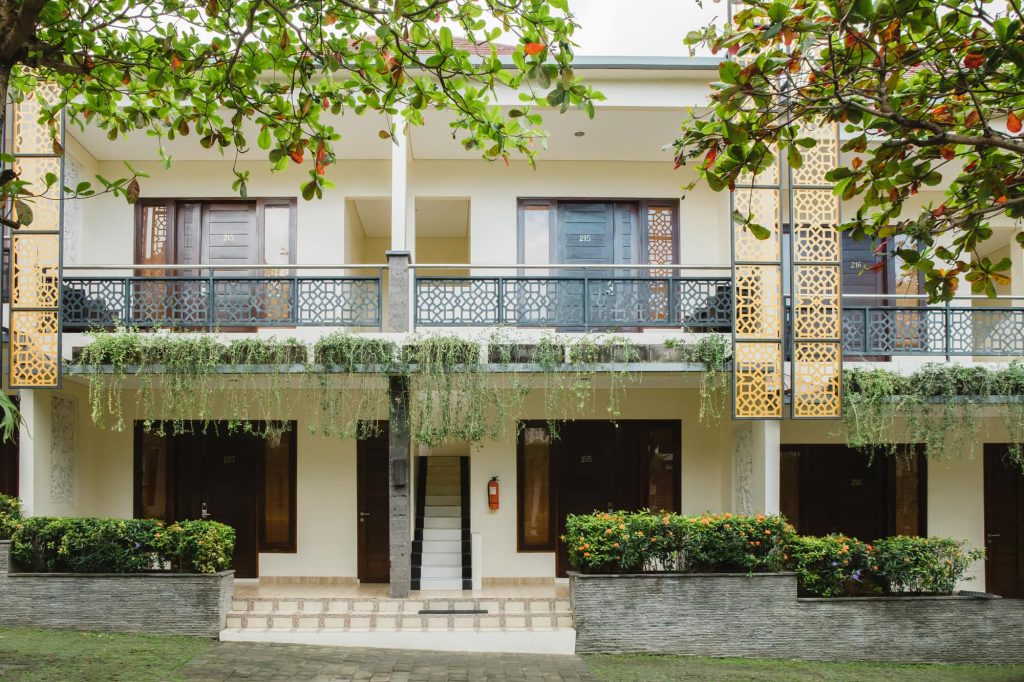
The hoses come on at half past five, before the sun clears the wall on the eastern boundary. Wayan starts at the frangipani court and works towards the pool terrace, watering at the root rather than over the leaf. An hour later the same water would be half gone to the air. By seven the beds are dark, the paving is drying, and the crew has moved on to sweeping.
From November the rain does the watering and the work shifts to drainage. Gravel channels behind the villa hedges get cleared by hand, one bucket of silt at a time, because a blocked channel means standing water, and standing water means root rot in the heliconia. After a heavy night the grass holds the print of a foot for a minute. We stay off it until it firms.
Dry season runs the other way. By August the topsoil in the open beds turns pale and powdery by mid-morning, so we mulch heavily with shredded coconut husk and old leaf litter, four fingers deep around anything young. Mulch buys three days between waterings. It also keeps the soil cool enough that the ginger under the walkway does not sulk and drop its lower leaves.
Everything green that leaves the beds goes to the compost bays behind the staff entrance. Grass clippings, prunings, spent flowers from reception, vegetable trimmings from De’ Kesambi. The heap is turned every ten days with a fork. It steams when opened and smells of warm bread and wet wood, never of rubbish. Eight weeks on, it goes back into the beds as dark crumb. We buy very little soil.
The garden looks unbothered, and it takes five people every morning to keep it that way.
The frangipani get cut back once a year, after the wettest weeks pass and before the flowering push. We take out crossing branches and anything hanging below head height on the path to the villas, cutting just above a fork so the tree breaks into three rather than shooting straight up. The sap runs milky and stains linen, so it is early work, done before guests are walking.
Plant choice does more for the gardens than any amount of labour. Heliconia, alocasia, pandan, bougainvillea, ylang-ylang, and the old jackfruit by the north wall all cope with a soaked month followed by a parched one. Where something has failed twice we stop replanting it and put in what the neighbourhood already grows well. The beds near the main pool are on their third scheme; this one has not needed rescuing.
Pests are handled by hand where possible. Mealybug on the alocasia comes off with a cloth and soapy water. Snails get collected after rain. The frangipani caterpillars arrive in numbers twice a year, strip a tree in four days, and are picked off in the cool of the evening. We keep the spraying to a minimum, because the garden is also where guests eat breakfast.
None of this is visible for long. A guest walking to the pool at nine sees wet stone, a frangipani in flower, and grass that has already been cut. The work sits an hour or two behind them, in the dark, in rubber boots. That is the arrangement we like. The garden looks unbothered, and it takes five people every morning to keep it that way.